
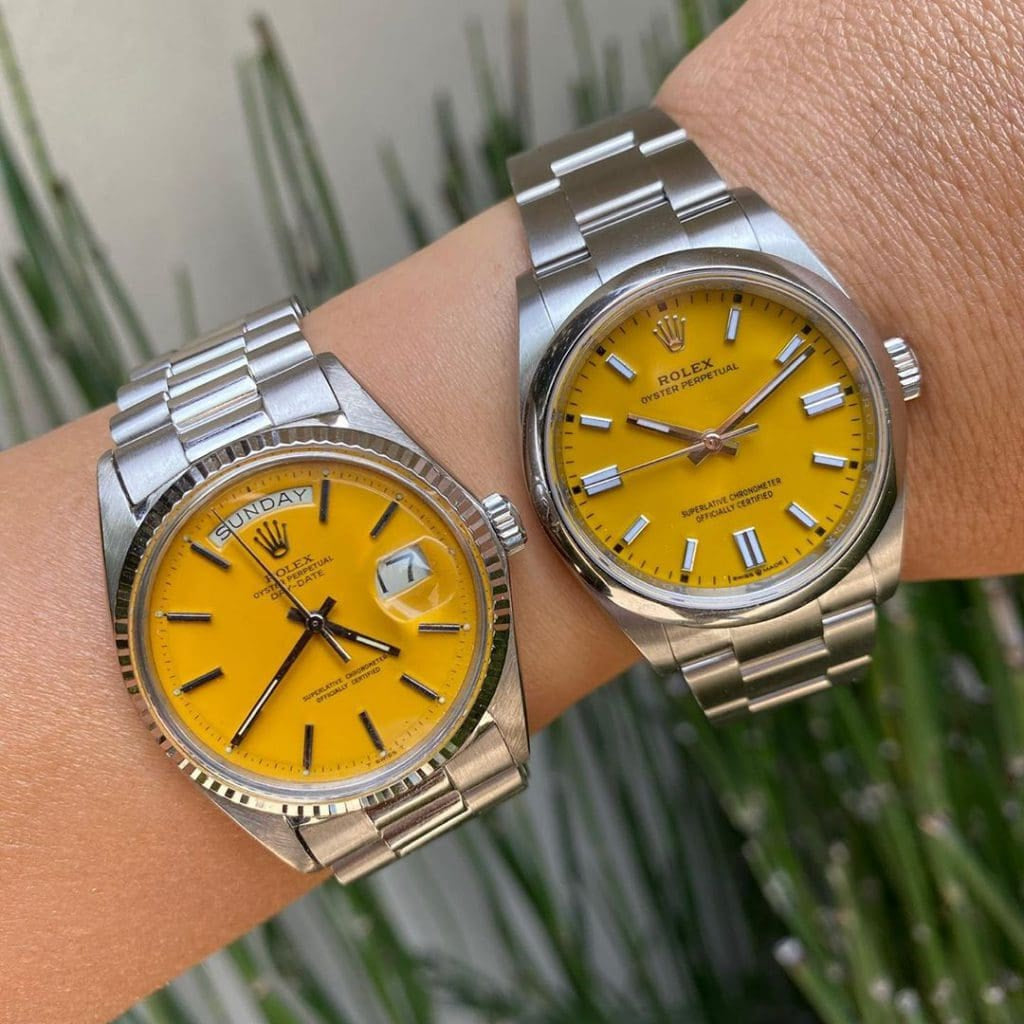
The Rolex Oyster Perpetual is often the first Rolex many people buy. It’s simple, clean, reliable, and doesn’t cost as much as a Daytona or a gold Day-Date. But because it’s so popular and relatively straightforward to copy, it’s also one of the most frequently faked Rolex models on the market.
By 2026 the quality of high-end replicas has improved dramatically. Some “super fakes” can fool even people who already own genuine pieces if they don’t know exactly what to look for. This guide is built specifically for the Oyster Perpetual — covering the details that matter most on this model (no date window, minimalist dial, 36mm or 41mm case, steel construction). These are the checks that catch the majority of counterfeits.
Why the Oyster Perpetual Is Such a Popular Target for Counterfeiters
The OP has no date complication, no rotating bezel, no chronograph pushers — it’s one of the purest expressions of Rolex design. That simplicity makes it easier for counterfeiters to reproduce the outside appearance without having to fake complex mechanisms. At the same time, demand for affordable Rolex models is huge, especially among first-time buyers who want the brand name without spending tens of thousands. The combination of high demand and relatively low complexity creates the perfect storm for fakes.
12 Detailed Ways to Spot a Fake Rolex Oyster Perpetual
Run through these checks in order. One or two small issues might be explainable; three or more red flags almost always mean it’s not genuine.
- Case Size and Proportions Genuine OP cases come in two main modern sizes: 36mm and 41mm. The proportions are perfect — the case sits balanced, the lugs have a subtle curve, and the overall thickness is slim (around 11.5–12mm including crystal).
Fakes often get the size slightly wrong (a 36mm fake might measure 35.8 or 36.3mm) or the lugs feel too straight or too thick. The case-to-bracelet transition can look clumsy.
Measure the case with calipers if possible, or compare side-by-side with a known genuine piece from our authentic Rolex Oyster Perpetual collection.
- Rehaut Engraving (Serial and Reference) Since 2008, Rolex moved the serial number to the rehaut (inner bezel ring) at 6 o’clock, and the reference at 12 o’clock. On a real watch the engraving is deep, sharp, and perfectly aligned.
Most fakes use shallow laser etching or acid that looks rough or uneven under magnification. The numbers are often spaced incorrectly or duplicated across multiple watches.
Use a loupe or strong phone zoom. The engraving should look carved cleanly into the metal.
- Dial Printing and Layout The Oyster Perpetual dial is extremely clean and minimal — no date window, no clutter. Printing is razor-sharp with perfect kerning and spacing. The coronet at 12 o’clock is crisp and symmetrical.
Fakes frequently have slightly fuzzy text, uneven spacing, or coronet that looks a little off-center or bloated. The “Oyster Perpetual” text can appear too thin or too thick.
Inspect closely with good light. Everything should look perfectly aligned and crisp.
- Hands and Applied Markers Hour markers on genuine OP are applied metal (not printed) and sit exactly flush. Hands are perfectly straight and aligned with markers at every hour.
Counterfeits often have markers that are printed or poorly glued, with visible gaps or misalignment. Hands can be slightly crooked or have rough edges.
Look from the side and tilt the watch — markers should be perfectly flat and even.
- Lume Application and Glow Rolex uses Chromalight lume on modern OP models — even application, bright blue-green glow that lasts hours.
Fakes usually have uneven lume (splotchy or too thin) and the glow is weak or fades quickly. Sometimes the color is off (more green or yellow).
Charge under bright light for 15 seconds, then go into darkness. A genuine OP lume is strong and consistent.
- Crown and Twinlock System The OP uses the Twinlock screw-down crown (single line under the logo). It should screw smoothly with no grittiness.
Fakes often have a rough screw action, a poorly stamped logo, or crown guards that feel loose or unfinished.
Unscrew and screw it back slowly — it should feel precise and firm.
- Crystal and Edge Finishing The sapphire crystal is perfectly flat with a clean edge. The transition between crystal and case is seamless.
Many fakes have a slightly domed or poorly fitted crystal, or visible glue marks around the edge.
Run your finger gently over the edge — it should feel smooth with no gaps.
- Bracelet, End Links and Clasp Genuine OP bracelets have solid end links (no rattle), tight tolerances, and a smooth Easylink extension system. The clasp is engraved cleanly.
Fakes often have hollow or rattling end links, loose bracelet feel, and a clasp that looks cheaply stamped.
Shake the bracelet lightly — there should be almost no play.
- Overall Weight and Balance A real OP has a reassuring, solid weight thanks to 904L Oystersteel. The watch feels balanced on the wrist.
Counterfeits are almost always noticeably lighter, especially in the bracelet and case.
Pick it up and compare — the difference is usually obvious once you’ve handled a genuine one.
- Seconds Hand Sweep Rolex movements run at 28,800 vph — the seconds hand sweeps smoothly (8 ticks per second).
Lower-grade fakes use quartz (one tick per second) or low-beat movements (visible jerk).
Hold it to your ear — it should be very quiet. Watch the seconds hand — it glides.
- Case Back Details and Rotor Sound The case back is solid metal (no glass display). When shaken gently, the rotor makes a soft, smooth rattle.
Fakes sometimes have display backs (Rolex never uses them on OP) or a loud, grinding rotor noise.
Shake lightly next to your ear — the sound should be subtle and mechanical.
- Box, Papers and 2026 NFC Card Modern Rolex warranty cards are green plastic with an NFC chip. The box is high-quality with clean stitching.
Fakes often have cheap boxes, misspelled cards, or NFC chips that don’t scan or link to fake sites.
Check the NFC with a phone if possible — it should open a legitimate Rolex page.
Common Fake Oyster Perpetual Red Flags in 2026
- Price far below market (genuine OP rarely sells for 60–70% off)
- Seller avoids showing the watch in person or insists on cash-only
- Listing uses generic stock photos instead of real watch images
- “Swiss movement” mentioned but no specific Rolex caliber
- Pressure to buy quickly (“last one”, “buyer waiting”)
Final Advice: When DIY Checks Aren’t Enough
Even if you go through all 12 steps carefully, some very high-end fakes can still pass visual and tactile checks. The only way to be 100% certain is to have a qualified watchmaker open the case and inspect the movement.
That’s why the safest approach is to buy from a trusted source that has already done this work.
Where to Buy a Guaranteed Authentic Rolex Oyster Perpetual
The easiest way to avoid all the stress is to buy from a dealer who authenticates every watch before it reaches you.
At EW Watches, every piece is opened, inspected by Swiss-trained watchmakers, and backed by our warranty. We have physical showrooms in Hong Kong, Düsseldorf, and Madrid — you can see and feel the watches in person if you’re nearby. For everyone else we provide fully insured global shipping and clear pricing.
You can browse our real Rolex Oyster Perpetual collection or start with our most accessible options at certified pre-owned Rolex watches.
If you’re looking for more affordable entry-level pieces, check our cheapest Rolex watches.
We also have broader authentication guides here: How to Tell If a Rolex Is Real or Fake (2026 Guide) How to Identify Real vs Fake Rolex Daytona
Don’t take chances with your first (or next) Rolex. Choose authentic, every time.


Share:
The Best Luxury Sports Watches of 2026: A Close Look at Eight Standout Models
Why Are Some Rolex Watches So Cheap? Is It Fake? (2026 Guide)