
Whether you're timing a lap on the racetrack, feeling the immediate magic of a tachymeter, or simply gazing at your Rolex Daytona or TAG Heuer Carrera and wondering what that mysterious numbered scale truly signifies—you are certainly not alone. Questions about watch tachymeters flood online forums like Reddit, ranging from "What is it, really?" to "How does it actually work?" and "Is it used, or just for show?"
Traditional watch articles often focus on racing heritage and flashy new releases, yet rarely delve into these fundamental and core curiosities. Unlike those approaches, we aim to cut through the noise and demystify it for you. From the tachymeter's origins in early 20th-century motorsports and aviation, to its underlying scientific principles, a detailed usage guide, and practical applications beyond the track—we'll explore it all comprehensively.
Whether you're a beginner puzzled by bezel functions or a seasoned collector weighing its everyday utility, this guide promises to unlock your understanding. We'll delve deeper into its importance, clarify common misconceptions (like its comparison to dive bezels), and offer tips for choosing the right tachymeter watch. Get ready: let's unlock the secrets of this iconic feature together.
What Is a Tachymeter on a Watch?
A tachymeter is essentially a scale etched or printed on the bezel (the ring around the watch face) or sometimes on the dial of a timepiece. It's designed to measure average speed over a fixed distance, like kilometers per hour or miles per hour, based on elapsed time. The word "tachymeter" comes from Greek roots meaning "speed measurer," and it's a clever analog tool that turns your watch into a quick calculator for velocity—or even other rates like heartbeats or production output.
Most tachymeter watches are chronographs, meaning they include a stopwatch function with pushers to start, stop, and reset timing. The tachymeter relies on this: you time an event with the chronograph's second hand, and where it points on the scale gives you the speed reading. Without a chronograph, a tachymeter is possible but largely pointless—it's like having a ruler without anything to measure. Some basic watches might feature one for aesthetic reasons, but it won't function properly without the timing mechanism.
Tachymeters come in fixed or rotating versions. Fixed ones are stationary and common on models like the Rolex Daytona, providing straightforward readings. Rotating tachymeters, seen on watches like the Breitling Navitimer, add versatility—you can align the scale for custom calculations or combine it with other tools like a slide rule for aviation math.

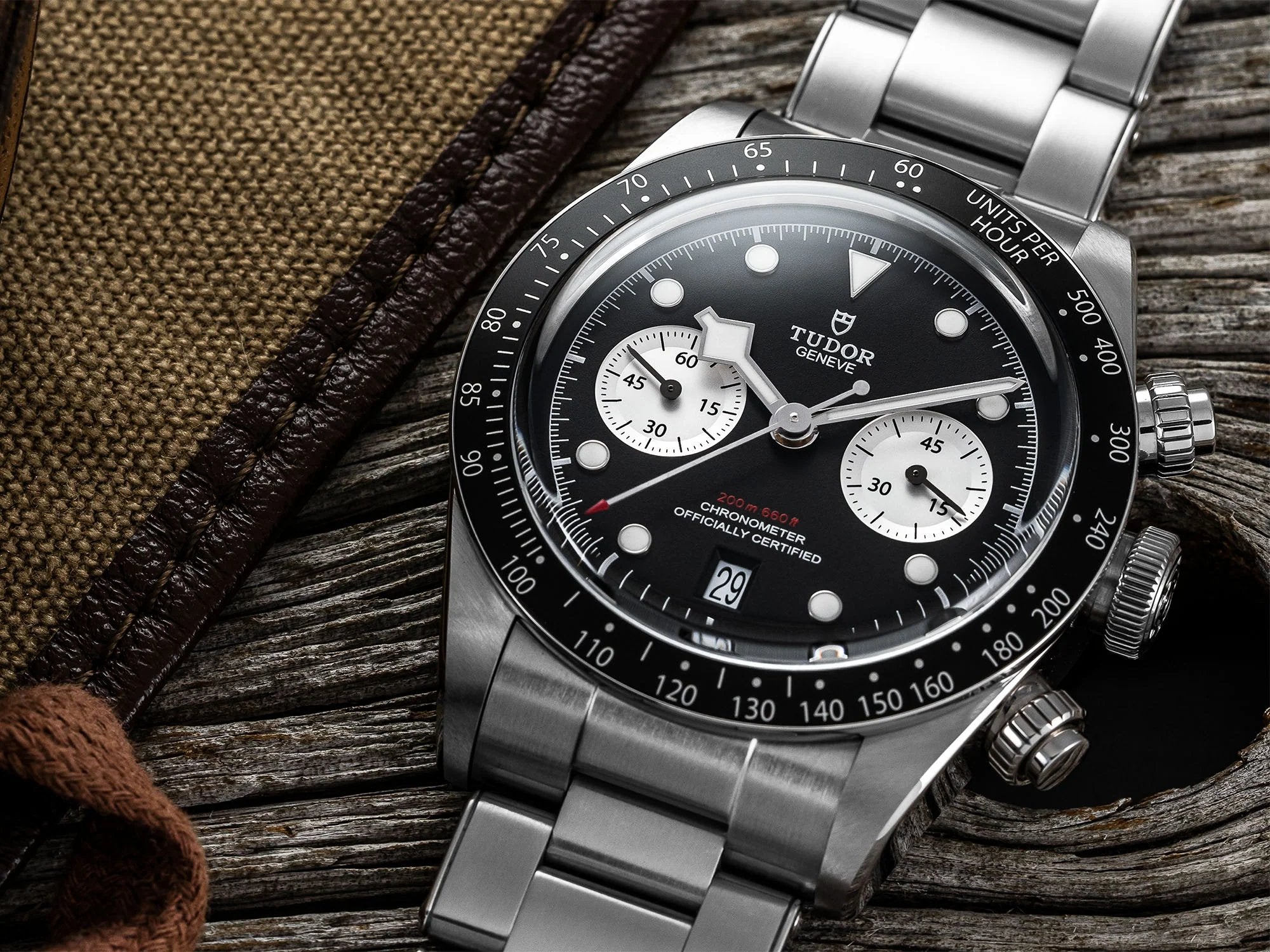
This visual aid shows a classic tachymeter scale up close, highlighting the logarithmic numbering that makes it work. In short, it's more than decoration; it's a bridge between timekeeping and real-world utility.
The History and Origins of Tachymeters
The tachymeter's story begins in the early 20th century, a time when the world was accelerating—literally. As automobiles and airplanes revolutionized transportation in the 1910s and 1920s, professionals like racers and pilots needed reliable ways to measure speed without relying on bulky or electronic devices, which were scarce or nonexistent. Watchmakers rose to the challenge, inventing the tachymeter scale as an ingenious addition to chronograph watches. It allowed users to calculate average velocity over fixed distances, such as a mile or kilometer, using just the watch's timing function.

The origins are deeply tied to motorsports and aviation. Swiss brands like Heuer (now TAG Heuer) pioneered it in the 1930s with models designed for rally drivers, where precise speed readings could mean the difference between victory and disaster. Meanwhile, aviation watches incorporated tachymeters for airspeed calculations, aiding pilots in navigation. The feature gained iconic status post-World War II, evolving with events like the Carrera Panamericana race, which inspired TAG Heuer's Carrera line.
Over the decades, tachymeters transitioned from practical tools to symbols of performance heritage. The 1960s saw Omega's Speedmaster, with its tachymeter bezel, become NASA's choice for space missions—earning the "Moonwatch" moniker. Today, while digital tech has overshadowed its utility, the tachymeter endures in luxury chronographs like Rolex's Daytona, blending vintage roots with modern precision. It's a testament to watchmaking's role in human innovation.
Why Are Tachymeters Associated with Racing and Other Industries?
Tachymeters have strong ties to specific industries due to their ability to provide quick, mechanical calculations for rates and speeds. Below, we break down the key associations, highlighting how this feature evolved to meet real-world needs.

Racing and Motorsports: The Speed-Measuring Core
The most iconic link is with racing, where tachymeters excel at measuring average speed over fixed distances like track segments or laps. In Formula 1, rally events, or endurance races, drivers use them for time intervals between markers (e.g., 1 km), optimizing performance and strategy. Brands like TAG Heuer reinforced this through models like the Carrera, named after the perilous Carrera Panamericana race, where accurate speed readings were vital for safety and competition.
Aviation: Precision in the Skies
In aviation, tachymeters helped pilots estimate airspeed and navigate without advanced electronics. Early flyers timed distances like runway lengths or flight paths, combining the scale with chronographs for on-the-fly calculations. Watches such as the Breitling Navitimer integrated tachymeters with slide-rule bezels, turning them into essential tools for cockpit math and fueling their enduring popularity among aviators.
Medical and Industrial Applications: Beyond High-Speed Thrills
Tachymeters extend to healthcare and manufacturing. Doctors historically used them to measure pulse rates—timing beats over a short interval and converting to beats per minute. Engineers apply them for production efficiency, calculating output rates per hour. These uses showcase the tachymeter's adaptability for any scenario involving timed rates.
The Broader Appeal: Function Meets Heritage
These industry connections arise from the tachymeter's versatile, analog design, offering reliable measurements in eras before digital tools. Today, while apps handle similar tasks, its professional heritage keeps it integral to chronograph watches, blending practicality with a nod to innovation.
The Science Behind It: How Does a Tachymeter Work?
At its heart, a tachymeter operates on a simple physics principle, but its clever design makes it feel like magic. Let's break it down without getting too technical, focusing on the essentials that make it tick.

The Core Formula: Speed Equals Distance Over Time
The tachymeter uses the basic equation Speed = Distance / Time. It's calibrated for a fixed distance—typically 1 kilometer or 1 mile. You time how long it takes to cover that distance with the chronograph, and the scale converts the elapsed seconds into speed units per hour (e.g., km/h or mph). No complex math required on your part; the watch does the conversion via its markings.
The Logarithmic Scale: Why the Numbers Curve That Way
The scale isn't linear—it's logarithmic, meaning the numbers start high (like 400 near the 9-second mark) and decrease as you go around (down to 60 at the 60-second point). This reflects reality: shorter times mean higher speeds. For example, covering 1 km in 15 seconds? That's fast— the scale reads 240 km/h. The curve ensures accurate readings across a wide range without needing extra dials.
Unit Conversions: Beyond Just Speed
Tachymeters are versatile for any rate measurement. Swap "distance" for beats, and it calculates heart rate (e.g., time 15 pulses for BPM). Or use it for production: time one item's assembly, and get units per hour. This flexibility turns it into a multi-tool, adapting the same formula to different contexts.
Step-by-Step Guide: How to Use a Tachymeter
Using a tachymeter is straightforward once you grasp the basics. It pairs with your watch's chronograph for quick calculations. Here's how to get started, with examples and pitfalls to avoid.
Essential Steps for Accurate Measurement
-
Select a fixed distance or unit: Choose something known, like 1 km (road markers) or 1 mile for speed, or 15 beats for heart rate.
-
Start the chronograph: Press the top pusher as the event begins (e.g., car passing a marker).
-
Stop the chronograph: Hit it again at the end (e.g., after the distance). The second hand points to the tachymeter scale.
-
Read the result: The number indicates units per hour—adjust if your base isn't 1 (e.g., halve for 500m).
Practical Examples Across Scenarios
-
Speed: Time a car over 1 km in 30 seconds; scale reads 120 km/h.
-
Heart Rate: Count 15 beats in time taken; reading gives BPM (e.g., 20 seconds = 180 BPM).
-
Production Rate: Time one widget assembly in 45 seconds; scale shows 80 widgets/hour.
Common Errors and Quick Tips
Avoid timing over 60 seconds (scale resets; use math for longer). Ensure clear markers to prevent inaccurate starts/stops. Practice on models like TAG Heuer Carrera for best results—clean the bezel for readability.
Real-Life Usage: Do People Actually Use Tachymeters?
While tachymeters look impressive, their everyday practicality sparks debate. Drawing from online discussions, here's a grounded look at usage, myths, and comparisons.

Actual Applications: Insights from Users
In Reddit threads, enthusiasts share niche uses: one user timed coffee brewing for consistent output rates, another measured walking pace during hikes. Professionals like doctors occasionally check pulses, and racers still use them for lap estimates. However, most admit rare application—perhaps once a year for fun experiments like timing trains or workouts.
Debunking Myths: Utility vs. Aesthetic Appeal
Myth: It's purely decorative. Reality: While many treat it as style (e.g., on luxury chronographs), it offers genuine function in timed scenarios, predating apps. Not everyone needs it daily, but it's far from useless—think analog backup in tech-free zones. The "just for show" label overlooks its heritage in precise industries.
Key Differences from Other Bezel Functions
Unlike a dive bezel (unidirectional for safety, times elapsed minutes underwater), tachymeters are bidirectional or fixed for rate calculations. Compared to a GMT bezel (tracks time zones), it's speed-focused, not temporal. This specialization makes it ideal for dynamic measurements, setting it apart in tool watches.
Tips for Choosing and Buying a Tachymeter Watch
Selecting your ideal tachymeter chronograph is a blend of appreciating its specialized function and finding a piece that resonates with your personal style and budget. Beyond the allure of its racing heritage, consider legibility and the quality of the chronograph mechanism. The inherent accuracy of your tachymeter reading hinges on two main factors: the precision of your chronograph movement and the clarity of the scale itself. A well-engineered mechanical chronograph, like those found in a TAG Heuer Carrera or an Omega Speedmaster, will offer reliable timing, fundamental to any speed calculation. While quartz chronographs deliver exceptional timekeeping precision at a lower cost, many enthusiasts gravitate towards mechanical movements for their craft and tradition.
For those venturing into the world of tachymeter watches, excellent entry-level options exist from brands like Seiko (perhaps a Speedtimer) or Tissot, offering robust functionality and classic designs without breaking the bank. Moving up, the TAG Heuer Carrera stands out as a quintessential choice, celebrated for its diverse range of movements (from quartz to their in-house Heuer 02 calibre), iconic design, and strong links to motorsports – truly embodying the spirit of the tachymeter. Other mid-tier contenders from brands like Longines or Tudor also present compelling blends of heritage and modern watchmaking. At the pinnacle, watches such as the legendary Rolex Daytona or the storied Omega Speedmaster Professional offer unparalleled prestige, meticulous craftsmanship, and enduring value, often becoming generational heirlooms. Ultimately, whether you prioritize budget-friendly utility, historical significance, or peak luxury, there's a tachymeter watch perfectly suited to your wrist and aspirations.
Conclusion
The tachymeter, far from being just a decorative engraving, is a brilliant testament to mechanical ingenuity—a direct link to the golden age of speed and precision. We’ve demystified its function, origin, and practical appeal, proving its enduring charm as an analog calculator. Embrace its power; don't just admire its aesthetic! Ready to find a timepiece that truly embodies this iconic feature? Explore our exquisite collection of tachymeter chronographs today.


Share:
The Celebrity Choice: Why the Rolex GMT-Master II "Pepsi" Rules Hollywood and Beyond